English
  日本語
日本語  français
  Deutsch
  Español
  italiano
  русский
  português
  العربية
  magyar
  Ελλάδα
inquiry@ljzcncmachining.com

In 2026, aluminum machining cost is largely determined before a cutter touches metal. Rising labor costs, tighter lead times, and higher quality expectations mean that the design file sent to a supplier contains most of the cost — in the form of setups, tool constraints, tolerance stack-up, and surface finish complexity that were never explicitly budgeted.
If you are working with china aluminum machining suppliers, the fastest path to lower unit cost and shorter cycle time is to apply design for manufacturability (DFM) rules that reduce the operations, tool changes, and risk features that inflate quotes. This guide provides five practical rules you can apply immediately.
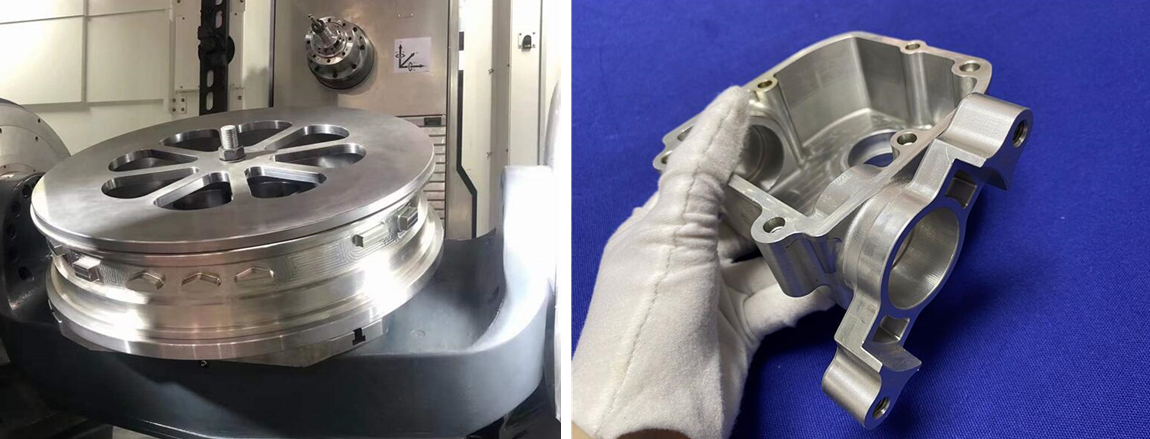
The most expensive machining decisions are often invisible in a design review. The features that look geometrically simple on a drawing are frequently the most operationally costly to machine.
| Design Feature | Cost Consequence | Why It's Often Missed |
|---|---|---|
| Deep, narrow pockets | Long-reach tools, slow feeds, chatter risk, high scrap rate | Depth looks reasonable on drawing; tool engagement is the hidden issue |
| Tight tolerances on non-critical surfaces | Added inspection burden, reduced speeds, more scrap | Designers apply uniform tolerance rather than function-based tolerance |
| Hard-to-clamp geometry | Multiple setups required; each setup adds queue time and labor | Part function drives geometry; manufacturability is secondary in early design |
| Small internal radii | Forces small-diameter end mills, slow feeds, frequent tool changes | Radii are drawn at the minimum that fits the function |
| Cosmetic finish on all surfaces | Masking complexity, anodize fixture cost, multi-step post-processing | Finish spec is applied globally rather than by surface function |
These cost drivers compound on repeat orders. A design that takes six setups instead of three does not just cost more per part — it takes longer to quote, longer to program, longer to run, and longer to inspect. The DFM investment pays back on every production run.
Every setup adds fixturing time, registration error risk, and queue time between operations. Parts that can be machined in one or two setups are fundamentally cheaper than geometrically similar parts requiring four or five.
How to apply it:
Add flat datum faces that provide stable, repeatable clamping surfaces
Consolidate features accessible from the same orientation into the same setup
Avoid features that require custom fixturing or specialized soft jaws
The geometry change does not need to be dramatic. Moving a hole pattern or adding a flat reference surface at the design stage often saves 20–30 minutes per part in fixture planning and setup verification.
Deep pockets with small widths require long-reach tools running at reduced feeds and depths of cut to manage deflection. The result is longer cycle time, higher tool wear, and elevated chatter risk that reduces surface quality and increases scrap rate.
How to apply it:
Increase pocket corner radii — a radius of at least 1/3 of pocket depth allows a larger end mill with better rigidity
Widen pocket openings where function permits
Standardise pocket depths across the part to reduce tool changes between depth levels
Avoid islands within pockets that require multi-axis approach or specialised tooling
A pocket that is 3 mm wider and uses a 6 mm radius instead of a 2 mm radius can reduce machining time on that feature by 40% or more.
Custom radii require custom tooling or multi-pass operations that approximate the radius with standard tools. Custom hole sizes require reaming or boring rather than standard drills. Both inflate cost without functional benefit in most applications.
How to apply it:
Use internal radii that correspond to standard end mill diameters (e.g., R3, R4, R5, R6 mm)
Use standard drill sizes for all through-holes and counterbores
Confirm with your china aluminum machining suppliers which tool sizes are in their standard library before finalising radii and hole specs
This single change can remove custom tooling cost and reduce tool change frequency — both of which affect cycle time and program complexity.
Uniform tight tolerances across a drawing are one of the most common sources of unnecessary machining cost. Every ±0.01 mm tolerance requires slower cutting speeds, more inspection steps, and higher scrap risk if any operation approaches the limit.
How to apply it:
Identify truly critical dimensions (shaft fits, bearing bores, mating faces) and specify tight tolerances only there
Apply ISO 2768 medium or coarse to all non-critical surfaces explicitly in the drawing notes
Separate functional dimensions from cosmetic dimensions in your drawing callouts
Review tolerances with your supplier during DFM — they will often identify tight tolerances on dimensions that do not affect function
A part with four critical tolerances and relaxed general tolerance is far less expensive to produce and inspect than the same part with twenty uniformly tight tolerances.
Applying the same surface finish specification to every face of a part adds masking complexity, post-processing time, and anodizing fixture cost. Most parts have three surface types: functional surfaces that need a controlled finish, cosmetic surfaces that need to look good, and internal or hidden surfaces that need neither.
How to apply it:
Mark finish-critical faces explicitly on the drawing; specify Ra where it matters
Mark cosmetic faces with the minimum acceptable finish (often Ra 1.6 or 3.2 is sufficient)
Mark non-critical internal or hidden faces as "machined finish acceptable"
Simplify cosmetic zones to reduce masking complexity for anodizing — complex boundaries between finish zones are expensive to mask accurately
DFM changes like larger radii, fewer deep pockets, and relaxed non-critical tolerances reduce machining time and cost.
| Metric | DFM Improvement Mechanism | Expected Direction |
|---|---|---|
| Cycle time per part | Fewer tool changes, larger cutters, fewer setups | Decreases |
| Tool wear and breakage cost | Larger tools at correct feeds; fewer long-reach situations | Decreases |
| First-pass yield | Reduced chatter risk; achievable tolerances | Increases |
| Setup count per part | Better clamping geometry; feature consolidation | Decreases |
| Programming complexity | Standard tools; predictable features | Decreases |
| Lead time | Simpler operations; faster quoting and setup | Decreases |
The ROI is strongest on repeat production orders. DFM changes made before the first prototype run save cost on every subsequent batch without additional design investment.
Step 1 — Send a complete package Provide 3D CAD, 2D drawing with tolerance callouts, target annual volume, material specification (6061, 7075, or other alloy), surface finish requirements, and a list of critical functional dimensions.
Step 2 — Request a DFM report from the supplier Ask specifically for: estimated setup count, tool plan, identified risk features, and the two or three design changes that would most reduce cycle time or scrap risk. A capable china aluminum machining suppliers partner will respond with specific observations, not generic feedback.
Step 3 — Revise the design Apply the supplier's DFM input alongside the five rules above. Focus revisions on: pocket radii and widths, tolerance zones, datum and clamping face geometry, and surface finish zone boundaries.
Step 4 — Prototype run with First Article Inspection (FAI) Run a small prototype batch and complete a full FAI against the revised drawing. Validate that functional dimensions are achieved and that the DFM changes do not affect part performance. Document any observations for the production drawing.
Step 5 — Lock production drawing and golden sample Finalise the production drawing with approved revisions. Approve a golden sample. Establish QC checkpoints for reorders — which dimensions are measured 100%, which are AQL-sampled, and what the acceptable scrap rate is per lot.
Q1: What is aluminum machining and what alloys are typically used?
Aluminum machining is CNC manufacturing that removes material from aluminum stock using milling, turning, drilling, and finishing operations to achieve precise geometry and tolerances. The most common alloys are 6061-T6 (good machinability, corrosion resistance, weldability — the general-purpose choice) and 7075-T6 (higher strength, often used in aerospace and structural applications). Alloy selection affects machining speed, surface finish quality, and post-processing options including anodizing.
Q2: When is aluminum machining better than die casting for a given part?
Machining is the better choice for low-to-mid production volumes (typically under 5,000–10,000 parts per year), parts requiring tight tolerances that casting cannot reliably achieve, designs still in iteration where tooling investment is premature, and applications where internal features or complex geometries are impractical to cast. Die casting becomes cost-competitive at high volumes where tooling cost amortises across a large production run and part geometry is stable.
Q3: How quickly do DFM changes pay back their design investment?
For most production parts, DFM changes pay back within the first production run — through reduced cycle time, fewer setups, lower scrap rate, and shorter lead time. The payback is strongest on repeat orders where the cost reduction compounds across every batch. A design revision that takes four hours of engineering time but reduces cycle time by three minutes per part pays back within the first 100-unit production run.
Q4: What should I measure during a DFM pilot run to confirm the improvement?
Track: cycle time per part before and after DFM revisions, scrap rate per lot, tool breakage or replacement frequency, number of setups required, inspection pass rate on critical dimensions, and total lead time from purchase order to shipment. These metrics provide the objective basis for confirming whether the DFM changes delivered the expected cost reduction and for identifying any remaining optimisation opportunities.
Q5: What information do china aluminum machining suppliers need to provide an accurate quote?
Provide: 3D CAD file in a standard format (STEP or IGES), 2D drawing with all tolerance callouts and surface finish specifications, material alloy and temper (e.g., 6061-T6), a list of critical dimensions with their functional purpose, anodizing or surface treatment requirements, prototype quantity and annual production forecast, and any assembly or fit constraints that affect dimensional requirements. Suppliers who receive this information can provide a meaningful quote with a DFM review — without it, quotes will be based on conservative assumptions that inflate cost.
Aluminum machining cost is primarily a design decision. Parts designed with fewer setups, standard tools, function-based tolerances, and strategic surface finish specifications cost less to quote, less to program, less to run, and less to inspect — every time they are produced. When you share DFM-optimised designs with china aluminum machining suppliers, you get faster quotes, more consistent quality, and lower scrap rates that compound across every reorder cycle.
Visit ljzcncmachining.com/aluminum-machining and submit your 3D CAD, 2D drawing, material specification, tolerance requirements, quantity forecast, and current cost or quality issues to receive a DFM review, recommended process plan, and quotation.
 日本語
日本語